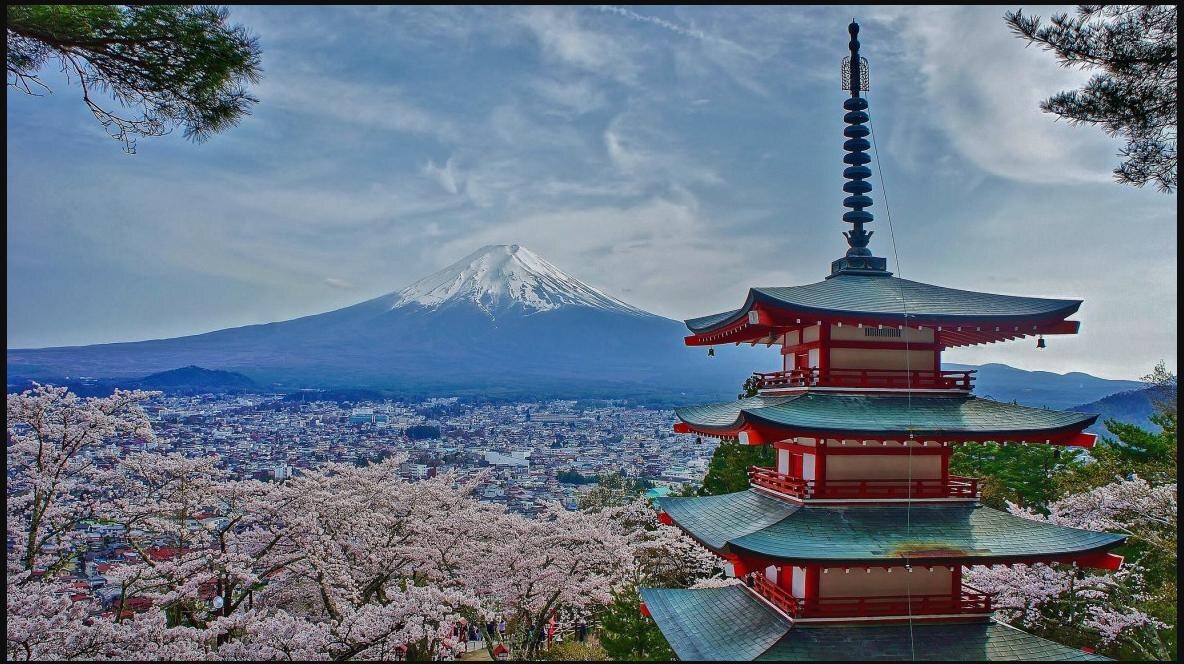
Photo: Manishprabhune / CC BY-SA 4.0
Cherry Blossom (Sakura) Season in Japan by Region
Sakura season is a wave that moves across Japan over roughly four months. When full bloom happens in each region, and how to plan a trip around it.
Last updated 2026-08-25
The short version
Cherry blossoms don't bloom on the same date nationwide — the bloom front (sakura zensen) moves from south to north over about six weeks, starting in Kyushu and western Honshu in mid-to-late March and reaching Hokkaido by late April or early May. Okinawa is the one exception: it blooms earlier and separately, in January and February, with a different species of cherry (more on that below).
"Full bloom" (mankai) usually arrives 4–10 days after the first flowers open, and good viewing typically lasts about a week after that before petals start falling. Forecasters publish updated predictions through the winter and early spring, and the closer you get to your travel dates, the more accurate they are — a forecast made in December is a rough guess; one made in early March is usually solid.
Okinawa: the outlier that blooms first
Okinawa's cherry blossoms are a different species — kanhizakura (Taiwan cherry), with deep pink, bell-shaped flowers that hang downward rather than the pale, outward-facing blooms seen on the mainland. They peak in late January through mid-February, months before anywhere else in Japan, mostly in northern Okinawa around Nago and Mt. Yae.
If your trip lands in Okinawa in winter, this is worth knowing about specifically — it's a real hanami experience, just not the one most people picture, and with a fraction of the crowds of the mainland's spring peak.
Kyushu, Shikoku & western Honshu (mid-to-late March)
This is where mainland sakura season typically starts. Fukuoka and Hiroshima usually reach full bloom in the last few days of March to the first few days of April, with flowering starting a week or so earlier. If your trip is fixed for mid-to-late March, this belt of the country is your best shot at catching peak bloom.
Tokyo, Kansai & central Japan (late March–early April)
Tokyo, Kyoto, Osaka, and Nagoya cluster tightly together, typically reaching full bloom in the last week of March through the first few days of April. This is the highest-demand window of the entire season — it covers Japan's most-visited cities, so accommodation books up and popular spots (Ueno Park, the Philosopher's Path, the Kamo River) get genuinely crowded at peak. If you can, book lodging as soon as your dates are set rather than waiting for the bloom forecast to firm up.
Elevation complicates the picture even within this belt. Yoshino, in Nara prefecture, is Japan's single most famous cherry blossom mountain — some 30,000 trees planted in bands up the slope, so the lower sections bloom first and the bloom visibly climbs the mountain over about two weeks, stretching the viewing window well beyond a single city's peak date (see our Nara guide below). Lake Kawaguchi, near Mt. Fuji, is another example: despite sitting close to Tokyo, its higher elevation pushes its peak to around the second week of April, a week or two behind central Tokyo.
Tohoku & the mountains (mid-to-late April)
Northern Honshu runs about two to three weeks behind Tokyo. Sendai typically reaches full bloom in the first week of April, but the more northern and higher-elevation spots — Hirosaki Castle in Aomori being the best-known — usually peak in the last week of April, giving Tohoku a noticeably longer runway than the crowded Kansai/Kanto window.
Hokkaido (late April–mid May)
Hokkaido closes out the season. Sapporo typically reaches full bloom around the third or fourth week of April, and areas further north or at higher elevation can push into early-to-mid May. If your trip is locked into late April or May and you specifically want cherry blossoms, Hokkaido is often the only realistic option left on the mainland.
How to actually plan around it
If your travel dates are flexible, work backward from the forecast: pick the region whose typical peak lines up with your window, and lean toward the earlier end of that region's range rather than the exact predicted full-bloom date, since flowers can be blown or rained off within days of peaking.
If your dates are fixed, do the reverse — figure out which region is statistically likely to be at or near peak on your actual travel dates, rather than hoping a single famous spot (like central Tokyo) happens to line up. A trip planned for early April, for instance, has a much better shot at Kyushu or Kansai than at Hokkaido.
However you plan it, treat any specific date here as a starting point, not a guarantee — bloom timing shifts by a week or more year to year depending on that winter's temperatures, and official forecasts aren't finalized until a few weeks out. Our Trip Planner can build a day-by-day itinerary once you've picked a region and window.
Related reading
Want a full itinerary, not just one article?
The Trip Planner builds a day-by-day plan around the regions and interests you pick.
Open Trip Planner